
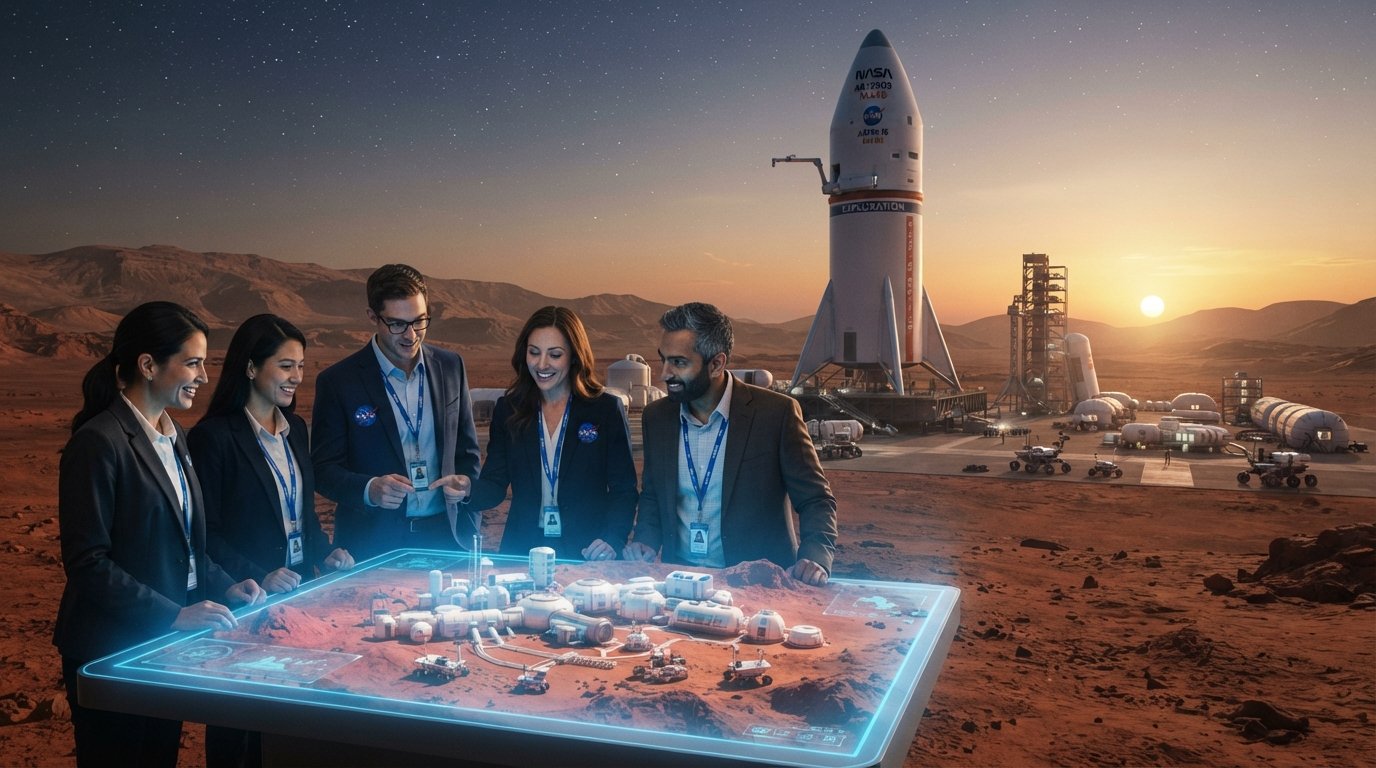
NASA is planning for astronauts to reach Mars in the 2030s, but that goal is not a confirmed launch date. The agency has not finalized a flight plan. For people following space exploration, the difference matters: years of planning and testing still stand between the goal and a launch.
The central questions are how NASA will prepare, what scientists hope to learn, and which technologies need more work. A human mission to Mars would be a major step in space exploration, but it depends on many decisions that remain open. The path forward is meant to build on earlier work, not skip straight to the red planet.
Key Takeaways
- NASA aims to send astronauts to Mars in the 2030s.
- The goal is not a confirmed launch date or final flight plan.
- Artemis and earlier spaceflight experience are part of the preparation.
- Science goals and crew safety will shape future mission choices.
- NASA intends to build experience in stages before a crewed Mars flight.
NASA intends to build experience in stages before attempting a crewed Mars flight. That approach starts closer to Earth and moves outward.
Inside NASA’s Plans for the First Human Mission to Mars: The Roadmap and Its Limits
NASA’s Mars goal is a destination, not a set launch date; the agency plans to prepare in stages. First, crews gain experience near Earth, then Artemis missions test operations near and on the Moon.
The lunar proving-ground strategy is preparation, not proof that a Mars flight date or final vehicle design is set. In-situ resource utilization (ISRU) means making use of materials found at a destination instead of bringing every needed resource from Earth.
Artemis can help test skills and systems for distant missions, but it does not set a Mars launch date or final vehicle design.
Artemis turns the Moon into a proving ground
The International Space Station (ISS) gives NASA and its partners experience with people living and working in space. Crews have rotated continuously since November 2000, usually staying about six months. The station orbits about 250 miles (400 kilometers) above Earth.
Those stays help teams learn how human spaceflight and life-support systems perform over time. Artemis extends that experience farther from Earth. Lunar missions are intended to test capabilities for longer and more distant operations.
The stages have different roles, and none alone proves that a Mars mission is ready.
| Stage | Location | Role in preparation | Concrete detail |
|---|---|---|---|
| ISS | Low Earth orbit | Human spaceflight and life support | About 250 miles high; crew rotations since November 2000 |
| Artemis | Moon and lunar space | Test operations farther from Earth | Artemis I flew uncrewed in 2022 |
| Human mission to Mars | Mars | First crewed mission to the planet | NASA goal for the 2030s |
SLS and Orion are the crewed-flight hardware
The Space Launch System (SLS) is NASA’s heavy-lift rocket. Orion is the crew capsule designed to carry astronauts beyond low Earth orbit. Together, they are part of the hardware for Artemis missions, not a complete Mars transport system.
Artemis I launched on November 16, 2022, without a crew. It traveled about 1.4 million miles (2.2 million kilometers), orbited the Moon for six days, and came within 80 miles (129 kilometers) of the lunar surface. Orion returned to Earth on December 11, 2022.
That flight tested the rocket and capsule on a lunar mission. It did not carry astronauts or establish that the same system can support a human trip to Mars. The roadmap explains how NASA may build experience; the next question is what crews could learn at their destination.
What science will astronauts investigate on Mars?
The search for signs of life is the highest-priority question, alongside research into Mars’ history and habitability. Scientists also want to understand how water, climate, and local conditions changed across the planet.
A National Academies report released on December 9, 2025, set out 11 priority science objectives and ranked evidence of past or present life first. The list is a research agenda, not a claim that life has been found.
Search for life and evidence of ancient water
Mars formed about 4.6 billion years ago. Early in its history, the red planet had abundant surface liquid water and a denser atmosphere. Its present environment is sharply different.
That contrast makes samples and site conditions important. Astronauts could examine rocks and soils in person, then choose follow-up targets based on what they find. Such work could help determine whether Mars once offered places where life could survive.
Researchers would also look for signs of prebiotic chemistry, the chemical steps that may come before life. Finding evidence of habitability would not prove that organisms lived there. The distinction matters when scientists interpret traces preserved in rocks.
Read the planet’s geological and climate history
Water and carbon dioxide shape questions about how Mars changed. Scientists want to trace where water moved, how it was stored, and what happened to the planet’s atmosphere. The answers could connect local features to broader climate shifts.
Geology offers another record of change. Layers, minerals, and landforms can help explain how the planet formed and evolved. Dust storms also affect the surface and can shape what instruments and people can observe.
Study how Mars affects people and living systems
Human research would cover more than the planet itself. Scientists need to understand how radiation and dust affect crew health, and how microbes behave in a habitat. A long stay also raises questions about reproduction and ecosystem stability.
These concerns link science to daily work. A crew’s habitat, equipment, and health all interact with the Martian environment. Five broad groups capture the priority questions:
- Evidence of life, prebiotic chemistry, and whether Mars could support life.
- Water and carbon-dioxide cycles across the planet.
- Mars’ geology and climate history.
- Dust storms, dust effects, and radiation exposure.
- Local resources, crew health, microbial stability, reproduction, and ecosystem dynamics.
The priorities can guide both the places crews visit and the tools they carry. They do not settle where a landing should occur. Scientific goals shape where crews might land and what each proposed campaign would emphasize.
Which first-Mars campaign could NASA choose?
A National Academies committee laid out four distinct ways to organize the first Mars surface campaigns. Each is an option for pursuing science, not a selected NASA flight plan.
The designs trade broad coverage against focused work at fewer places. Each option includes three landings, but the landing pattern and main research focus differ.
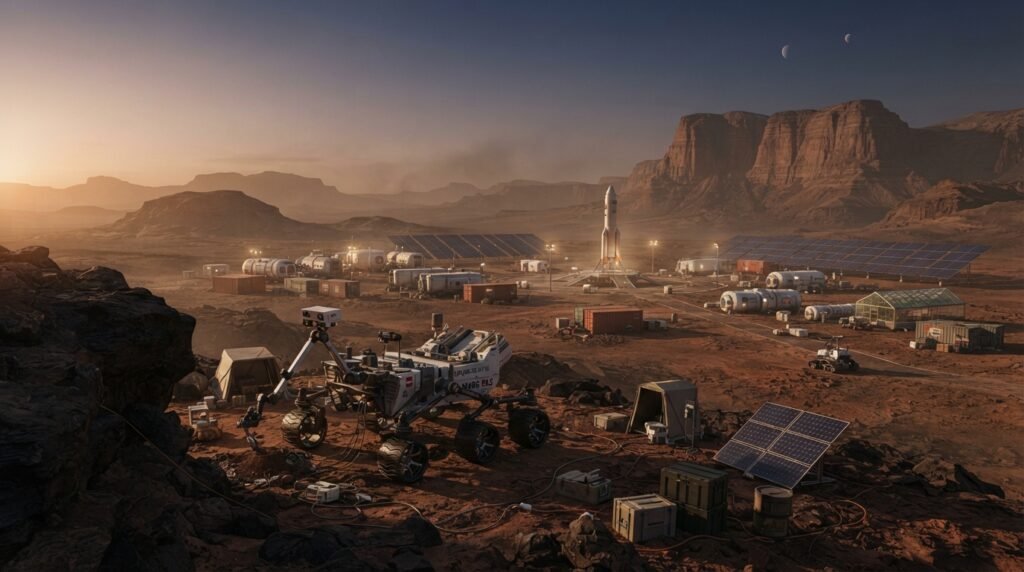
The 30-Cargo-300 pattern uses a 30-sol scouting stay, cargo delivery, and a 300-sol crew stay. A sol is a Martian day. The three-site design instead plans three 30-sol stays.
| Campaign | Landing pattern and focus | Main advantage | Main trade-off |
|---|---|---|---|
| Mars Science Across an Expanded Exploration Zone (30-Cargo-300) | One zone about 62 miles (100 kilometers) wide in radius; 30-Cargo-300 | Designed to address all 11 objectives across one zone | Depth depends on one zone and its local features |
| Synergy of Mars Science Measurements (30-Cargo-300) | 30-Cargo-300; measurements useful at different sites | Flexible findings can help compare areas | Less specialized coverage at any one site |
| Seeking Life Beneath the Martian Icy Crust (30-Cargo-300) | 30-Cargo-300; deep drilling about 1.2-3.1 miles (2-5 kilometers) | Focuses on a deep search for life | Drilling needs complex equipment that could fail |
| Investigating Mars at Three Sites (30-30-30) | Three 30-sol stays in distinct environments | Offers a wider range of environments | Shorter stays mean shallower investigations |
The expanded-zone option gives crews time to work within one exploration zone. Its focus may offer depth, but results would depend on the chosen area and its features.
The measurement campaign favors data that can apply across different sites. The deep-drilling campaign instead targets material below the icy crust, where equipment must reach miles underground. The three-site plan visits varied settings, but allows less time at each.
Each option balances breadth, depth, location, and risk differently. Those choices connect to the realities of a long crewed mission.
How long would the trip and Mars stay take?
A one-way trip to Mars is estimated to take about six to seven months and can cover up to 250 million miles (402 million kilometers). That estimate gives a sense of the time and distance crews would face.
Astronauts could spend as many as 500 days on the Martian surface before returning to Earth. That is a possible long stay, not a promise for every crew or mission design.
The journey spans months in each direction
The outbound and return trips each take an estimated six to seven months. A one-way journey may cover up to 250 million miles, or 402 million kilometers. The route and total time depend on the mission design.
During that time, the crew would travel inside a spacecraft far from Earth. They could not expect a quick return if a problem arose. The time and distance make reliable onboard systems essential.
Surface work may last many months
A surface plan could keep astronauts on Mars for as many as 500 days. Some campaign designs use shorter stays, so the longest estimate does not describe every mission.
The full time away depends on both the travel plan and the work planned on Mars. Crews would need to rely on their equipment and one another during long periods of isolation. Regular resupply from Earth would not be a practical fallback.
That commitment affects how teams plan food, water, health care, and repairs. Astronauts would have to keep working even when help from Earth takes time to arrive. The long timeline leads to the systems and safeguards needed to keep the crew alive and able to work.
What still has to be solved before astronauts can land?
A small technology test is not the same as a system that can support astronauts for a long mission. Before crews depend on Mars equipment, NASA must show that key systems work together and can keep working.
Mars’ thin atmosphere and dusty environment make landing, resource use, and surface equipment difficult. NASA’s Mars 2020 rover carried MOXIE, a technology demonstration designed to make oxygen from atmospheric carbon dioxide. Mars’ atmosphere is about 95% carbon dioxide.
A small oxygen-making test does not equal a full crew-scale supply system. Mars crews would need systems that work reliably in a thin, dusty environment.
Robotic missions must reduce uncertainty
Robotic missions and rovers can test equipment before people rely on it. MOXIE showed that oxygen production from Mars’ air could be tested on the planet. A demonstration is not a complete crew-scale oxygen supply system.
Robotic work can also help teams learn about landing areas and surface conditions. Yet a machine test cannot answer every question about how equipment performs during daily crew work. The human mission will need systems built for longer use.
Crewed systems must work far from Earth
The ISS gives NASA experience with life-support systems. Lunar missions are intended to test technologies such as habitats, radiation shielding, and dust mitigation. Mars would add greater distance and a different surface environment.
Key preparation needs include:
- Reliable entry, descent, and landing.
- Life support for air, water, and food.
- Radiation protection and ways to measure risk.
- Dust control for people and equipment.
- Power and communication over long distances.
- ISRU for oxygen or other useful local resources.
These needs depend on one another. A habitat needs steady power, and a crew needs air and water even when repairs take time. Mars’ carbon-dioxide atmosphere may offer a resource, but the thin air and dust complicate its use.
NASA’s objectives guide planning, but the specific architecture and operational details remain unsettled. The central takeaway is a long-term goal that depends on solving crew-safety and surface-operation problems.
Conclusion
A human mission to Mars is a goal NASA is preparing toward, not a fixed-date commitment. Reaching that goal depends on staged preparation, science-led planning, and solutions for crew safety and work on the surface.
The 2030s aim does not guarantee a launch in that decade. Readers can follow official NASA Artemis and Moon to Mars architecture updates to track changes in timelines and mission plans as the design develops.
FAQ
Does NASA want to put humans on Mars?
What was NASA’s first mission to Mars?
Could a human survive a trip to Mars?
Will humans live on Mars by 2050?
Can you survive on Mars for 2 minutes?
About the Author